A practical guide: why construction waste is not household waste, what the legal options are, and what to bear in mind.
Construction waste must not go into a household waste bin — it is a separate waste stream and there is a fine for it. There are three lawful options: take it to a licensed reception facility yourself, hire a skip, or order removal with carrying out. This page explains when each option works out cheapest, and what you must not do with construction waste.
Once the refurbishment is finished, the question is what to do with the waste. The bin outside your building is not meant for it, you are not allowed to dump it at the edge of a wood, and not every municipal recycling point accepts construction waste. This page sets out every legal option — including the ones where you do not need our service at all. If you have a trailer and five bags on the ground floor, taking them yourself will be cheaper, and we say so plainly.
Construction waste is a separate category of waste. If it ends up in the household bin, the cost is usually passed back to the building — and in practice that means to you.
If you have transport and the volume is small, this is the most economical option. Just mind the weight limits and the opening hours.
When the waste has to come down from an upper floor, when the volume is large, or when you have no transport.
Old corrugated roofing sheets and asbestos cement are not ordinary construction waste and need licensed collection.
Fill in the request form and add a few photos. We will reply within 5 minutes.
The crew arrives at a time you choose — often the same day or the next.
We work the price out from the photos and agree it with you. We only start once you have confirmed.
We work cleanly and tidy up after ourselves.
We take requests through the form
Add a few photos — we reply within 5 minutes with a price.
Book a collectionThis is the most common misunderstanding, and it tends to end with a bill from the building manager.
The bin outside your building is for household waste. Construction waste is a separate category with its own handling arrangements. If construction waste goes into the household bin, the waste contractor can refuse to empty it, and the cost is usually passed back to the building — which in practice means to you.
Even a modest amount of mortar or tiles makes a bin heavy enough that the lifting gear on the refuse lorry either cannot raise it or is damaged trying. That is a separate reason why contractors leave such bins unemptied.
Dumping construction waste somewhere it does not belong is an administrative offence. On top of the fine, you will normally have to cover the cost of clearing it as well. These places are often watched nowadays, and there is almost always something in the waste that points back to where it came from.
There are three: take it yourself to a licensed reception site, use a municipal sorted-waste yard if it accepts the material in question, or book a removal service. Each has its merits — there is a comparison below.
| Option | Who it suits | What you do yourself | What to bear in mind |
|---|---|---|---|
| Take it yourself to a reception site | Small volumes, if you have a trailer or a van | Load it, drive it, unload it, pay the gate fee | You need transport; a car boot is not suitable for heavy waste on weight grounds |
| Municipal sorted-waste yard | Small volumes, individual materials | Drive it there and sort it by material | Not every yard accepts construction waste; volumes and material types are limited |
| Removal service | Medium and large volumes, waste still indoors, an upper floor with no lift | Nothing — you just let us in | Costs more than taking it yourself, but includes carrying out, transport and disposal |
If you have a trailer and five bags of waste on the ground floor, taking it yourself is usually cheaper, and we will tell you so honestly. The service starts to pay for itself when the waste has to come down from an upper floor, when the volume is large, or when there is no transport.
Construction waste reception sites normally charge by weight rather than by cubic metre. That means concrete and mortar cost considerably more than the same volume of timber or plasterboard.
The most common mistake when taking waste yourself: a car and trailer have a permitted laden mass, and bags of mortar reach it faster than you would think. An overloaded trailer is both dangerous and an administrative offence.
Many reception sites require materials to be at least roughly sorted, and the rate for a mixed load can be higher. Companies often need a confirmation document for the waste they have handed over as well.
Asbestos-containing materials — old corrugated roofing sheets, asbestos cement — are not ordinary construction waste. They need separate, licensed collection, and most ordinary reception sites will not take them.
Reception sites generally open on weekdays and some on Saturday mornings. If you are planning to take waste yourself, check the opening hours first — a wasted trip to a closed gate is a common problem.
Inert materials — concrete and brick — are usually crushed and reused as aggregate. Timber goes for recycling or energy recovery, and metal goes for scrap.
If you go with the service, we hand the waste over at a licensed waste reception site that is authorised to accept it. You do not have to think about weights, sorting or opening hours.
Fill in the form and our specialist will get back to you shortly.
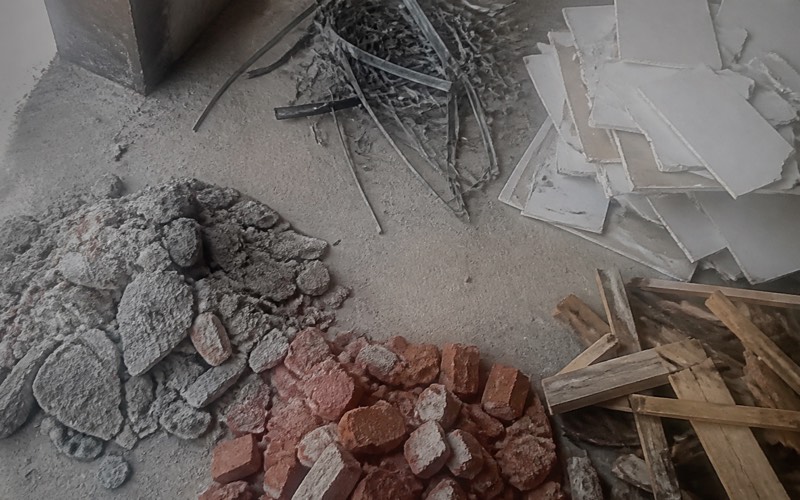

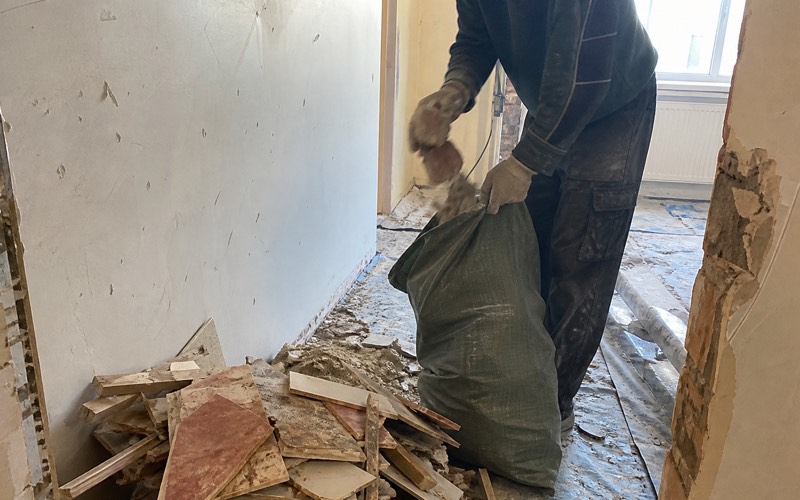
Renovation waste from a flat — upper floors with no lift included.
Find out moreFill in the form and we will reply within 5 minutes!
We have received it. We will be in touch within 5 minutes.