We take down non-load-bearing partitions in flats and offices. The rubble leaves in the same visit.
Taking down a partition is one of the most common jobs there is, whether you are opening the kitchen into the living room or knocking two rooms together. We take down non-load-bearing brick, plasterboard and chipboard walls, collect the rubble and take it away. First we check the wall is not load-bearing and that no live services run through it — we do not touch load-bearing structures without a design and building authority approval.
We establish whether the wall is load-bearing and whether cables or pipes run inside it.
We sheet up doorways and adjoining rooms. A brick wall throws up a great deal of fine dust.
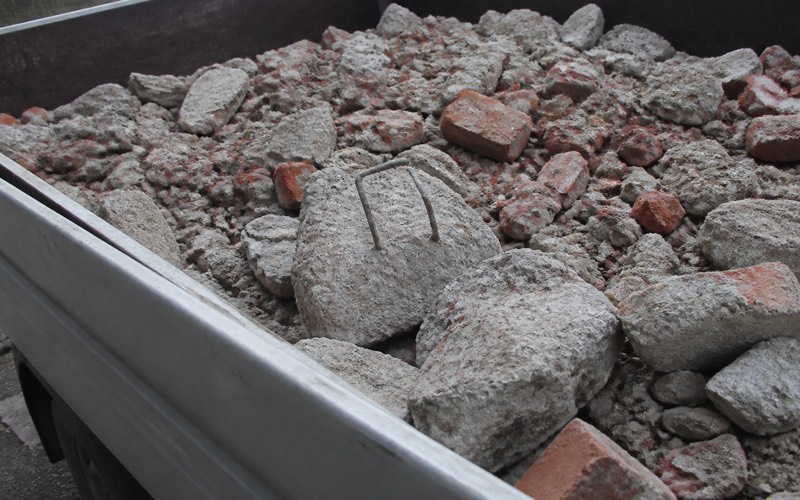
A tonne and a half of brick does not sit in your hallway — out and away the same day.
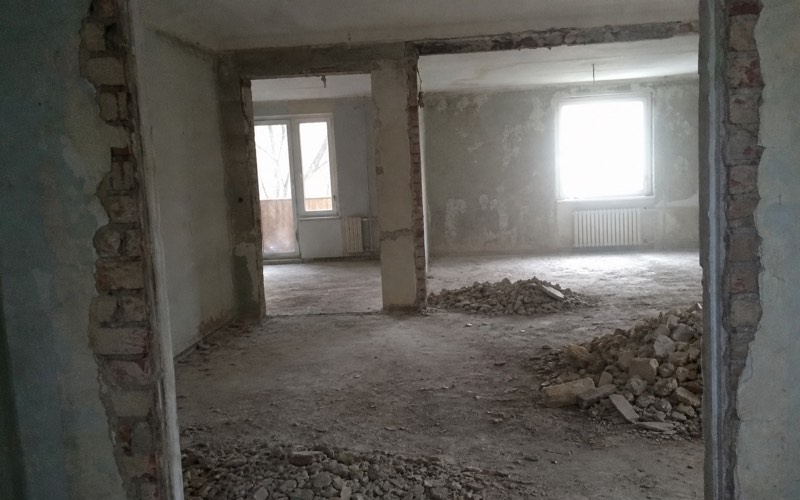
We sweep the room and the stairwell. You are left with an empty space, not a pile of rubble.
Fill in the request form and add a few photos. We will reply within 5 minutes.
The crew arrives at a time you choose — often the same day or the next.
We work the price out from the photos and agree it with you. We only start once you have confirmed.
We work cleanly and tidy up after ourselves.
We take requests through the form
Add a few photos — we reply within 5 minutes with a price.
Book a collectionThat is the first question, and everything else follows from it. Here is what to check.
Load-bearing walls are usually thicker — in residential blocks often 20 cm and up — and run through every floor in the same position. Non-load-bearing partitions tend to be a slim 8–12 cm, in plasterboard, chipboard panels or thin brick. The only reliable proof is the building design or a structural engineer's opinion.
Altering a load-bearing structure in a flat requires a design and building authority approval. Without it the work is unlawful, and the problems surface when you sell or make an insurance claim. A non-load-bearing partition usually only needs notifying the building manager, though rules differ.
We take down non-load-bearing partitions. If there is doubt about the wall, we say so beforehand and suggest you find out — rather than knocking it down and reporting it after. It is your property, and we do not put it at risk.
Older walls often carry electrical cabling and sometimes water pipes. We check for live services first, and if we find any we agree how to proceed.
| Wall type | 10 m² gives | Weight |
|---|---|---|
| Brick wall (12 cm) | 1.2–1.5 m³ | around 1500 kg |
| Plasterboard partition | 1.5–2 m³ | around 250 kg |
| Chipboard panel wall | 1.5–2 m³ | around 400 kg |
| Aerated concrete blocks (10 cm) | 1–1.2 m³ | around 600 kg |
A brick wall weighs six times what a plasterboard one does — which is why the removal price differs even though the volume is much the same.
Fill in the form and our specialist will get back to you shortly.
Fill in the form and we will reply within 5 minutes!
We have received it. We will be in touch within 5 minutes.